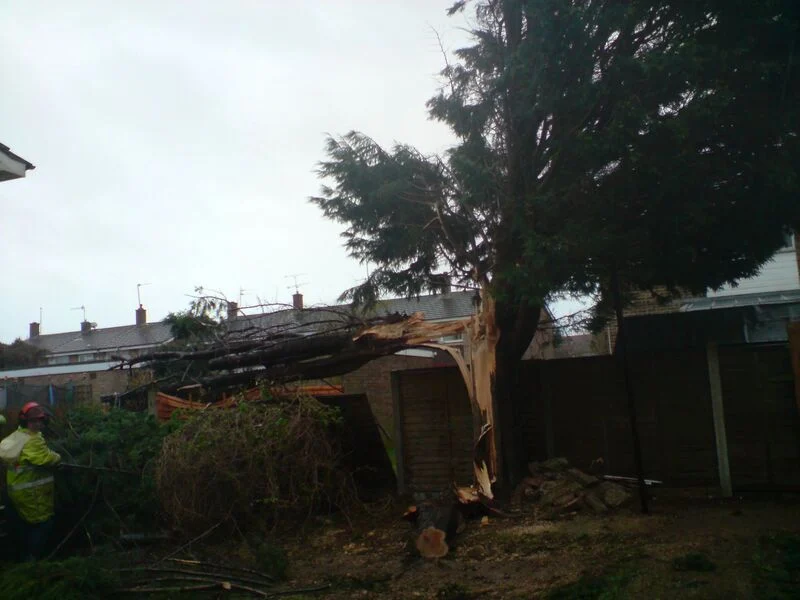
24/7 Emergency Tree Surgery
Storm damage, fallen trees and dangerous limbs, dealt with around the clock across Worthing and West Sussex.
Call first
01903 231321, any hour.
If a tree has come down, is leaning onto a building, or has a limb hung up in the canopy, tell us where you are and what has happened and we will tell you honestly how quickly we can get to you.
Before we arrive
- Keep everyone well clear, including pets. A hung-up limb can come down without warning, and the area under a damaged tree is the dangerous part.
- Do not try to move it yourself. Storm-damaged wood is under tension in ways that are not obvious, and a chainsaw in a loaded limb is how people get badly hurt.
- If there is any power line involved, call 105 first. That is the free national power-cut number and it routes to UK Power Networks locally. Do not approach the tree, do not touch anything in contact with the line, and wait for them. We cannot work on it until they have made it safe.
- If the tree has hit a building and there is any doubt about the structure, get everyone out and call the fire service on 999.
- Photograph everything, from a safe distance, before anything is moved. Your insurer will want it, and so will the council if the tree turns out to be protected.
What counts as an emergency
- A tree down across a drive, road or garden
- A tree leaning on a house, garage, conservatory or fence
- A large limb torn out but still hanging in the crown
- A split trunk or a major union that has failed
- Root plate lifting, visible ground movement at the base after wind or heavy rain
Not everything needs a night call-out. A branch on the lawn can wait until morning, and it will cost you less. We will say so.
Protected trees in an emergency
The TPO and conservation-area exemption for trees presenting an immediate risk of serious harm applies here, but notice to the council is still required, and you have to be able to show afterwards that the danger was real. Photographs before the work are what make that case. We document what we do as a matter of routine.
Insurance claims
Most storm damage is a claim. We provide written documentation of the condition we found and the work carried out, with photographs, in the form insurers ask for. If you can, speak to your insurer before work starts, some require it, though not at the expense of leaving something genuinely dangerous standing.
Making it safe now, tidying up later
Emergency work is usually two stages. The first visit removes the danger: the limb comes down, the tree comes off the roof, the drive is cleared. Fine work, grinding the stump and finishing the site can follow in daylight at normal rates, which keeps the emergency element of the bill down.
Common questions
What counts as an emergency?
A tree down across a road or drive, a tree leaning on a building, a limb hung up in the crown, a split trunk, or ground lifting at the base. A branch lying on the lawn can wait until morning and will cost you less.
How fast can you get here?
Depends where you are and what else is happening, after a named storm every tree surgeon in Sussex is out at once. Call and we will give you an honest time rather than an optimistic one.
A tree has hit my house, who do I call first?
If there is any doubt about the structure, or anyone is hurt, 999. If a power line is involved, 105. Once the immediate danger is handled, call us and photograph everything from a safe distance before anything is moved.
There's a tree on a power line, what do I do?
Call 105, the free national power-cut number. Do not approach the tree and do not touch anything in contact with the line. UK Power Networks will make it safe. We cannot legally or safely work on it until they have.
Will my insurer pay, and what do you give me for the claim?
Storm damage is usually covered, though policies vary. We provide written documentation of what we found and what we did, with photographs, in the form insurers expect. Speak to them before work starts if you safely can.
Do you charge more at night or weekends?
Emergency call-out is charged differently from planned work, because you are paying for a crew to turn out at short notice. We tell you the basis before we come, not afterwards.
A tree fell from next door into my garden, whose responsibility is it?
Generally the tree owner's, but insurers often argue it, particularly if the tree was healthy and the storm exceptional. Photograph everything, tell both insurers, and do not let a dispute stop something dangerous being made safe.