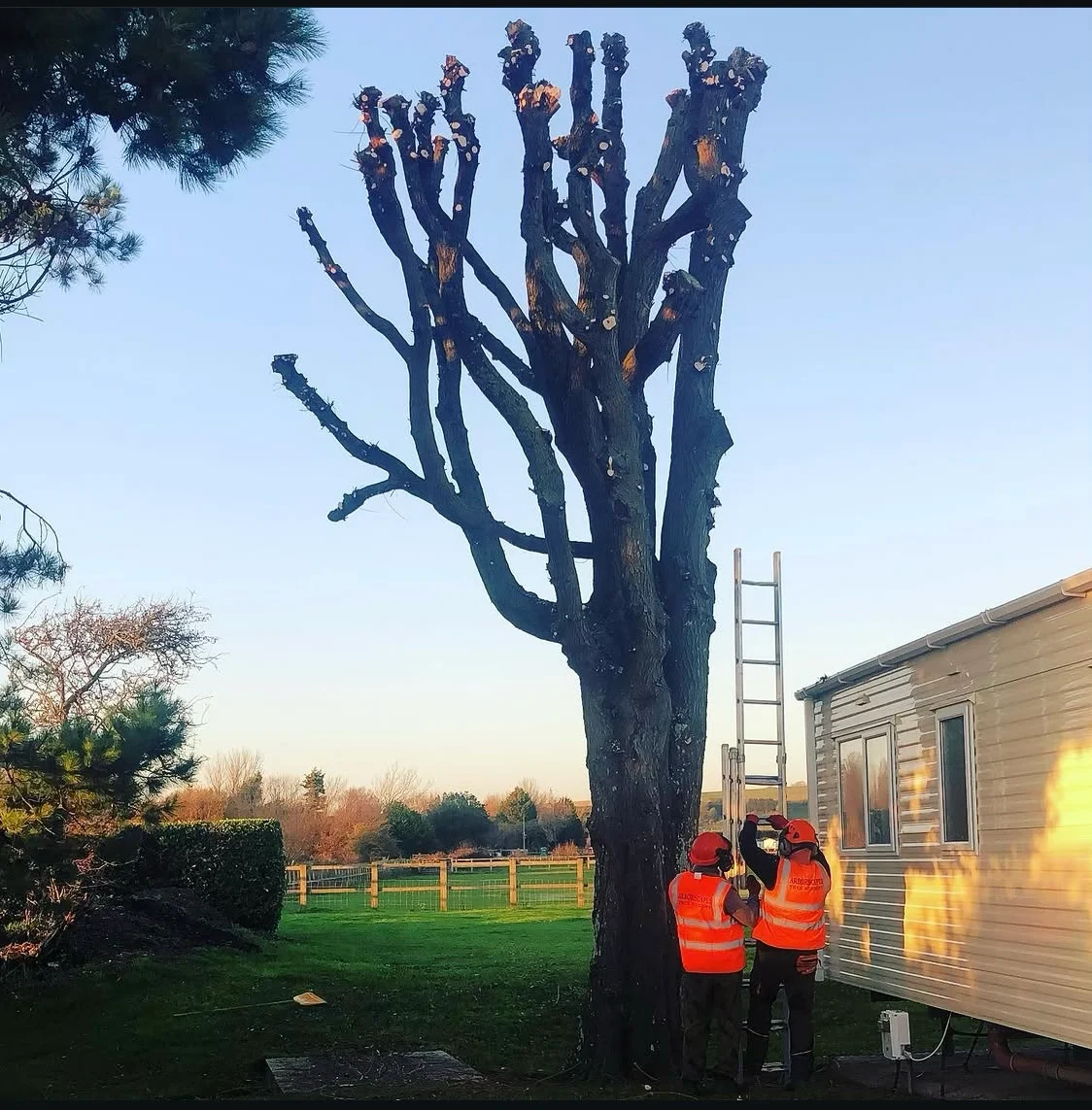
Pollarding
Cutting a tree back to its main framework so it regrows from the same points, common on street trees and old willows.
What pollarding is
Pollarding cuts a tree back hard to the same set of points on the trunk or main branches, the pollard heads, and lets it regrow from there. Done regularly, it keeps a tree at a fixed size indefinitely instead of letting it reach full height.
Which trees suit it
It suits species that respond strongly to hard pruning and put on vigorous new growth: willow, poplar, plane and lime are the common ones, which is why you see it most on street trees and old estate trees planted in a fixed space.
It works best on a tree trained into the cycle early, or one that has been pollarded before. Starting it late on a tree that has never been cut this way is a bigger, harder decision, and not always the right one.
When it should be done
In the dormant season, late autumn to early spring, once the tree has stopped active growth for the year.
Once a pollard cycle starts it needs keeping up. Cutting back to the same points every few years is the whole point, rather than leaving the tree to grow away and coming back to a far bigger cut later.
The bird nesting season runs 1 March to 31 August and active nests are protected under the Wildlife and Countryside Act 1981. We check before we start.
Permissions
A TPO or a conservation area means council consent before pollarding, exactly as for any other tree work. We handle the application.
How we quote
Free and on site, no obligation. We will tell you honestly if a tree is a good candidate for pollarding, or if another approach suits it better.
Recent work
Pollarding we have carried out around Worthing and West Sussex.
Willow Pollarding, Caravan Park
A willow tree pollarded back to keep it contained, done every few years for a family-run caravan park.