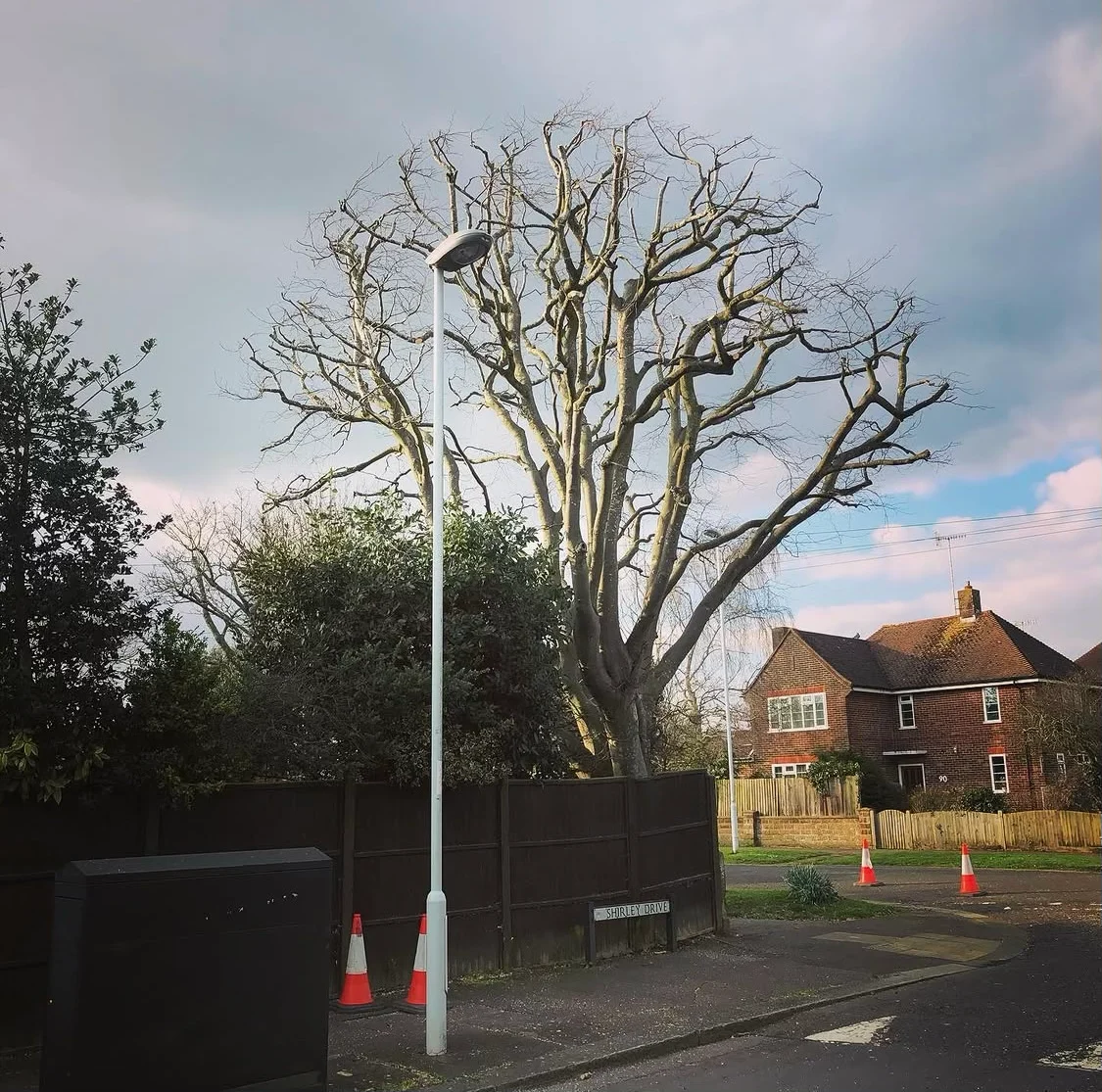
Crown Reduction & Reshaping
Reducing the overall size of a tree's crown while keeping its natural shape, for trees that have outgrown their space or need reshaping after storm damage.
What a crown reduction is, and what it isn't
A crown reduction shortens the branches back to a suitable growth point so the whole crown becomes smaller, while keeping the tree's natural outline. Done properly, a reduced tree still looks like a tree.
It is not topping. Topping cuts limbs back to blunt stubs, leaves large open wounds that struggle to seal, and forces a mass of weak regrowth that is more dangerous in ten years than the original tree was. We don't top trees, and we'll say so if that is what you have been quoted for elsewhere.
When you need one
- Branches are over the neighbour's roof, conservatory or garage
- The back of the house never gets any sun
- The tree has grown into a phone or power line
- You are uneasy about it in high winds
- Storm damage has left the crown lopsided
- The tree has simply outgrown a small garden
How we do it, to BS3998
We work to BS3998:2010 _Tree work, Recommendations_, the British Standard for arboriculture. In practice that means:
- A reduction is specified as a percentage of the crown radius, not the height. "Take a third off" is measured off the spread, not chopped off the top.
- We keep reductions to roughly 30% or less in one operation. Beyond that you are stressing the tree rather than managing it.
- Every cut goes back to a suitable growth point, a side branch at least a third the diameter of the stem being removed, so the wound has a living limb to draw on.
- Final cuts sit just outside the branch collar. No flush cuts, no stubs.
- No lion-tailing: we don't strip the interior growth and leave tufts on the ends, which loads the limb tips and makes failure more likely.
Some species take it better than others
This is where experience shows. A few we deal with regularly around Worthing:
- Beech and cherry respond poorly to heavy reduction. Better to go lighter and come back more often than to take a lot in one go.
- Lime throws dense epicormic regrowth from almost every cut, so a hard reduction buys you a shaggy tree within two seasons.
- Holm oak, common along the seafront, tolerates fairly hard reduction and takes salt wind well.
- Conifers, leylandii, cypress, will not regenerate from brown wood. Cut past the green and it stays brown permanently. We can reduce the top; we cannot take the sides back beyond the live foliage and have it recover.
When it should be done
Most broadleaves are best reduced in the dormant season, late autumn to early spring. Some are exceptions:
- Birch, maple, walnut and hornbeam bleed heavily if cut in late winter or spring, better in late summer.
- Plum, cherry and other _Prunus_ should only be cut between June and August, to avoid silver leaf infection.
There is also the law to consider. Under the Wildlife and Countryside Act 1981 it is an offence to damage an active bird's nest. The main nesting season runs 1 March to 31 August, and we check for nests before starting any job in that window. Cavities and loose bark are checked for bats, which are protected under the Conservation of Habitats and Species Regulations 2017.
Do you need permission?
If the tree has a Tree Preservation Order, or stands in a conservation area, yes, and doing the work without it is a criminal offence. A TPO application takes the council up to eight weeks; conservation-area work needs six weeks' written notice. We handle the paperwork as part of the job.
What happens on the day
We need somewhere to put the van and chipper, ideally within dragging distance of the tree. You don't usually need to be home, but we do need access, and if the work is over a boundary, the neighbour needs to know. We work normal hours, sheet up beds and lawns where there's a risk of damage, and clear up before we leave. Logs stay with you if you want them; otherwise they go.
How we quote
Free, on site, and no obligation. We don't price crown reductions off a photograph, access, the drop zone, what's underneath and the tree's actual condition all change the job, and none of them are visible in a picture.
Recent work
Crown Reduction & Reshaping we have carried out around Worthing and West Sussex.
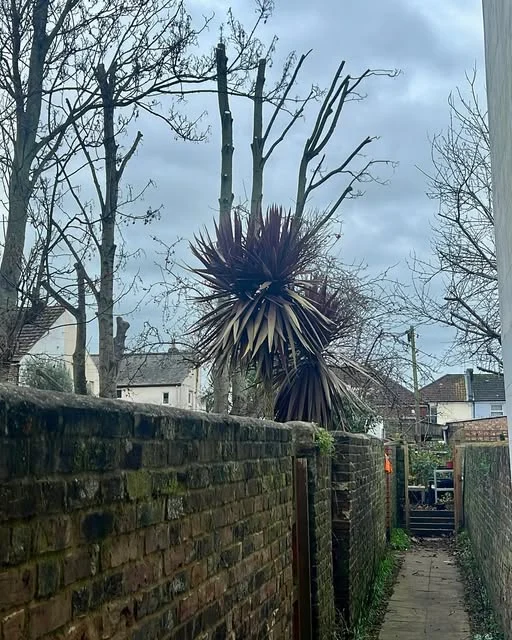
Street Trees Over the Pavement
Street trees reduced back over a pavement and a garden wall, giving clearance underneath.
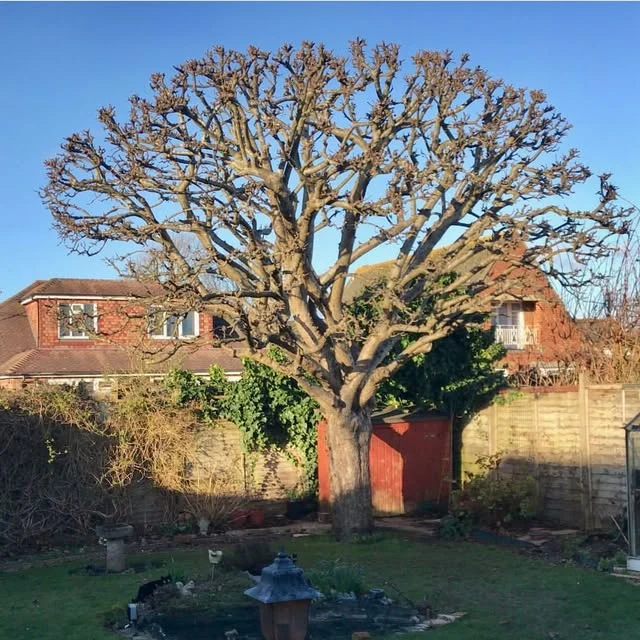
Mature Garden Tree
A large garden tree reduced back off the house while keeping its shape.
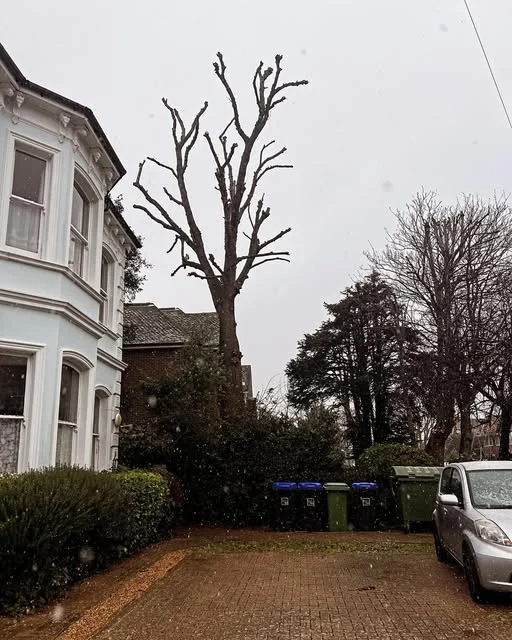
Street Tree Reduction
A mature street tree brought back hard over a Victorian frontage, clear of the roofline and the parking below.
Common questions
What's the difference between a crown reduction and topping?
A reduction shortens branches back to a suitable growth point and keeps the tree's natural shape. Topping cuts limbs to blunt stubs, leaving large wounds and forcing weak regrowth that becomes a hazard later. We don't top trees.
How much can you safely take off?
Usually up to about 30% of the crown radius in one operation, and less on species that respond badly. Taking more stresses the tree and often produces a burst of weak regrowth that undoes the work.
Will a reduction kill my tree?
Not if it is done properly and to a sensible percentage. A reduction specified to BS3998, cut back to proper growth points, is routine management. Repeated heavy topping is what kills trees.
Will it grow back, and how often will I need it done?
Yes, it is management, not a permanent fix. Depending on species and how hard the reduction was, most trees need revisiting every three to five years. Vigorous regrowers like lime come round sooner.
Can you reduce a tree that has a TPO?
Yes, with the council's consent. We make the application for you as part of the job. The council has up to eight weeks to decide, so it is worth starting early if you have a deadline.
Which trees don't respond well to reduction?
Beech and cherry take heavy reduction badly. Conifers such as leylandii won't regenerate from brown wood at all, cut past the green foliage and it stays bare. We'll tell you before we start if reduction is the wrong approach for your tree.